


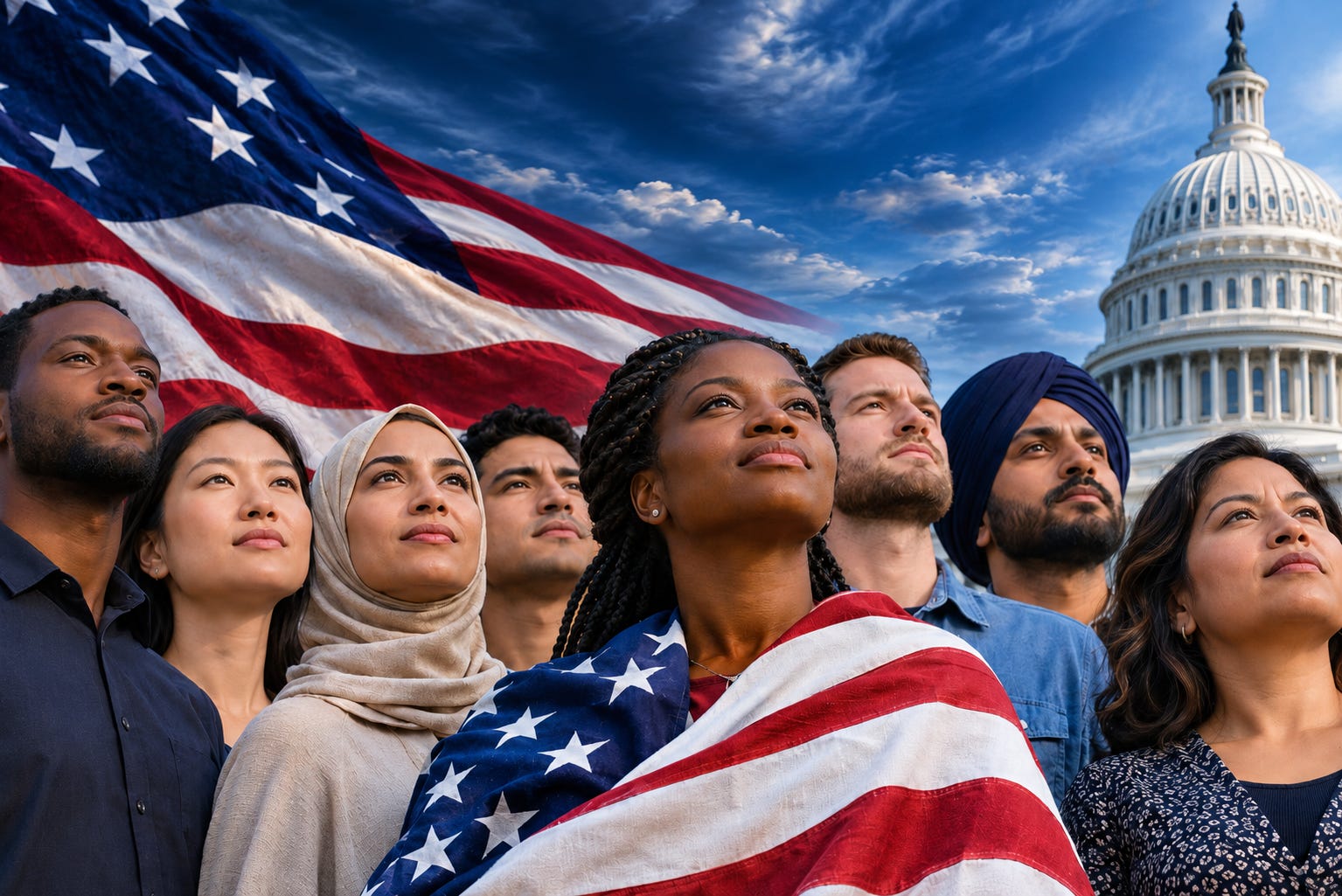
Our ancestry tells the story of where we came from. Our American identity declares who we are.
On November 6, 2026, newly elected United States Senator Abdul El-Sayed of Michigan made a statement that caught my attention. Speaking at an Arab American gathering in Virginia, he declared, “I know we’re here in DC, which of course is the capital of the United States of America, but Michigan is the capital of Arab America.” His remarks were made at the CONNECT Arab America Empowerment Summit, just days after his election to the United States Senate.
Now, I understand the sentiment. Michigan, particularly the Detroit metropolitan area and the city of Dearborn, is home to one of the most prominent communities of Americans of Arab descent in the country. These communities have deep roots in Michigan, and their contributions to the state’s economy, culture, and civic life are undeniable. Perhaps Senator-elect El-Sayed was simply celebrating that heritage. Perhaps his statement was intended to be humorous, a lighthearted acknowledgment of the audience before him. I am willing to grant him that charitable interpretation. But I believe there is a much larger issue here, one that deserves serious consideration.
When did America become a collection of ethnic Americas? When did we begin speaking of our country as though it were a federation of separate peoples, each with its own ethnic identity, political interests, geographical centers, and competing claims to the American experience? And more importantly, what happens to the American experiment when we increasingly organize our national identity around the very distinctions that our founding ideals call us to transcend?
Consider the implications of this language. If Michigan is the capital of Arab America, why shouldn’t Selma, Alabama, declare itself the capital of Black America? Why shouldn’t Los Angeles become the capital of Korean America? Why shouldn’t Westwood, California, become the capital of Iranian America? Why shouldn’t Miami claim to be the capital of Cuban America, or Minneapolis the capital of Somali America? Each of these communities has a legitimate cultural history. Each has contributed to the American story. Each has every right to celebrate the customs, traditions, languages, and achievements of its ancestors. But that is precisely where I believe we must draw an important distinction.
There is a difference between celebrating the heritage of Americans and creating the perception of separate Americas. The former enriches our national identity. The latter risks fragmenting it. A community can celebrate its history without declaring a separate national identity. A neighborhood can preserve its traditions without implying that its inhabitants belong to a distinct American people. And a politician, particularly one elected to represent citizens of every ethnicity and background, should be especially mindful of the language used to describe the nation he has been entrusted to serve.
I am not suggesting that Senator-elect El-Sayed intended to divide America. A single remark is not sufficient evidence of such an intention. But intentions do not eliminate implications. Words shape perceptions. Perceptions shape identities. And identities eventually shape political expectations. When we continually describe ourselves as separate ethnic Americas, we should not be surprised when people begin to think of themselves as members of separate political constituencies rather than fellow citizens of one nation.
One of the most remarkable things about the United States is that American citizenship is not defined by membership in a particular ethnic group. An American need not have English ancestry, a European surname, a particular skin color, or family roots reaching back to the Mayflower. America is a nation built around a set of political ideals. The Declaration of Independence proclaimed that all men are created equal and endowed by their Creator with certain unalienable rights. The Constitution established a framework of government designed to secure liberty, distribute political power, and protect the rights of citizens. Our national motto, E Pluribus Unum, means “Out of many, one.” Not out of many, many. Out of many, one. That is a profound distinction.
Our Founders did not perfectly live up to the principles they proclaimed. The institution of slavery, the treatment of Native Americans, and the long struggle for equal citizenship exposed enormous contradictions between America’s founding ideals and its historical practices. But those contradictions do not invalidate the ideals themselves. Indeed, much of America’s progress has come from Americans demanding that the country more faithfully honor its own founding promises. The abolitionist movement, the civil rights movement, and the struggle for equal protection under the law all appealed, in important ways, to the proposition that American rights should not depend on ancestry or race. The goal was not to create multiple Americas with separate standards of citizenship. It was to make the promise of one America available to everyone. That is the principle worth preserving.
I have long been uncomfortable with the practice of placing ethnic identity before American identity. African-American. Arab-American. Korean-American. Iranian-American. Mexican-American. I understand why these terms emerged, and I recognize that many people use them simply to describe their heritage, not to express divided loyalty. The hyphen itself does not make someone less patriotic. But I believe the language we normalize influences the way we understand ourselves. Even when these labels are intended to celebrate ancestry, they can become political categories that emphasize our differences more than our common citizenship. And I want to propose a different approach.
Instead of African-American, why not say American of African Descent, or AAD? Instead of Korean-American, why not American of Korean Descent, or AKD? Instead of Iranian-American, why not American of Iranian Descent, or AID? Instead of Arab-American, why not American of Arab Descent, or AArD? This may seem like a minor linguistic adjustment. Some might even dismiss it as semantics. But I believe there is something important in the ordering. The first word is American. Not because our ancestry is unimportant. Not because we must abandon our history. And certainly not because we should be ashamed of where our families came from. But because our nationality is the civic identity we share.
Our ancestry explains our origins. Our citizenship establishes our common political belonging. And our commitment to the American constitutional order provides the foundation upon which people of vastly different backgrounds can live together as equals. I am not an African who happens to be American. I am an American whose ancestry is African. That distinction matters to me.
I was born in Ghana. I came to America as an immigrant. I eventually became an American citizen. My African heritage did not disappear when I became an American. I still cherish the culture, traditions, and experiences that shaped my upbringing. But I did not become an American merely to recreate Ghana within America’s borders. I became an American because I embraced the opportunity, liberty, responsibilities, and constitutional ideals of this country. My birthplace is part of my story. America is my country. And I want the word American to be the first thing people understand about my national identity, not an afterthought attached to my ancestry.
My deeper concern is not really about terminology. It is about what happens when ethnic identity becomes the organizing principle of political life. There are political movements and ideological factions in America that increasingly view society primarily through the lens of group identity. Rather than evaluating citizens as individuals with equal rights and responsibilities, they encourage us to see ourselves as members of competing demographic categories. Our political significance becomes tied to our race. Our interests are presumed to follow our ethnicity. Our experiences become evidence of collective identity. And our representatives are increasingly judged by their ability to deliver benefits to particular demographic constituencies.
This is a dangerous direction for a constitutional republic. Because once we accept that America is fundamentally a collection of ethnic groups with distinct political interests, the logic of politics begins to change. Instead of asking what policies best serve the American people, we begin asking what policies best serve our particular group. Instead of building coalitions around principles, we build coalitions around identities. Instead of appealing to our common citizenship, politicians are incentivized to appeal to our differences. And instead of competing over ideas, we risk competing over which groups should receive influence, recognition, resources, and preferential treatment. That is not the America I believe our founding principles call us to build.
A government committed to equal citizenship should not treat Americans as permanently divided ethnic constituencies. It should protect the rights and liberties of individuals regardless of their ancestry. Our ethnicity should never determine the extent of our rights, the weight of our citizenship, or the government’s obligation to protect us. We have already seen what happens when Americans begin treating ethnic identity as a political mandate. Consider the presidency of Barack Obama.
For eight years, America had its first president of African descent. It was a historic achievement, one that demonstrated how far the country had come from the days when Americans of African descent were denied even the most basic rights of citizenship. Yet one criticism of his presidency continues to surface in discussions about his legacy: What did Obama do for Black people? How many times have we heard some variation of that question? For some, the criticism goes even further, suggesting that Obama did little or nothing specifically for the Black community. This dissatisfaction was measurable. In a June 2016 Gallup survey, 52% of Black respondents said Obama’s policies had not gone far enough to help Black Americans.
But I find the underlying expectation worth examining. Why should the president’s ancestry create a special obligation to citizens who share that ancestry? Obama was not elected president of Black America. He was elected president of the United States of America. His constitutional responsibility was to serve the entire nation. That includes Americans of African descent, of course. It also includes Americans of European, Asian, Arab, Hispanic, and every other ancestry.
There is nothing wrong with evaluating whether a president’s policies improved conditions for particular communities. We should examine disparities, identify legitimate problems, and hold government accountable for its performance. But there is a fundamental difference between asking whether a president’s policies benefited a community and suggesting that a president owes that community special political allegiance because of his ethnicity. Imagine Americans of Irish descent demanding that a president with Irish ancestry prioritize their ethnic interests above those of other citizens. Imagine Americans of German descent expecting a president with German ancestry to govern primarily on their behalf. Would we consider that an appropriate understanding of presidential responsibility? Then why should the standard change when the president is Black?
Representation is not ownership. Shared ancestry does not create an exclusive political mandate. This is precisely the danger of allowing ethnic identity to become the organizing principle of citizenship. We begin to see elected officials not as representatives of the American people, but as representatives of their respective ethnic communities. And once we accept that framework, we should not be surprised when politicians begin appealing to Americans primarily as members of those communities.
We have another revealing example in our national culture. There is a song called Lift Every Voice and Sing, often referred to as the “Black National Anthem.” The song has a meaningful and moving history. Written by James Weldon Johnson and set to music by his brother, John Rosamond Johnson, it was first publicly performed in 1900 and became an important expression of hope, perseverance, faith, and the struggle for freedom among Black Americans. The NAACP adopted it as an anthem of that struggle. I have no objection to the song itself. Its history deserves recognition, and its message of liberty is compatible with the highest aspirations of our nation. But I question the designation.
Why does any racial group in America need its own national anthem? We have a national anthem, The Star-Spangled Banner. It belongs to every American. Black Americans. White Americans. Americans of African descent. Americans of Arab descent. Americans whose families arrived yesterday and Americans whose ancestors were here at the founding. Certainly, communities can have cultural songs, historical hymns, and traditions that reflect their particular experiences. But when we describe a song as a separate national anthem for a racial group, I believe we should ask what message that terminology communicates. Are we celebrating a unique chapter of American history? Or are we unintentionally reinforcing the perception that there are separate nations within our nation?
I recognize that the designation emerged during segregation, when Black Americans were denied the equal citizenship that the United States professed to guarantee. Its historical meaning cannot be separated from that injustice. But the legitimate struggle for inclusion should ultimately point toward the fulfillment of a common American identity, not the permanent institutionalization of separate ones. I do not want a White national anthem. I do not want an Arab national anthem. I do not want an African national anthem within the United States. I want all Americans to recognize themselves in the anthem of the country we share.
We can remember distinct histories without requiring distinct national identities. We can celebrate the accomplishments of different communities without imposing separate expectations upon political leaders who share their ancestry. And we can acknowledge that Americans have experienced our country’s history differently while still affirming that we share one national future. This is not a call to erase racial or cultural history. It is a call to ensure that our differences never become more politically important than our common citizenship. Because if every ethnic group has its own political constituency, its own presumed representatives, its own geographical capital, and its own national symbols, we must eventually confront an uncomfortable question: What exactly is left of the United States of America? E Pluribus Unum was never a promise that our histories would be identical. It was an aspiration that our different histories could become part of one American story.
Now, I anticipate the obvious objection. Does this mean Americans must abandon their cultural heritage to become fully American? Absolutely not. I reject that proposition entirely. I want Americans of Italian descent to celebrate their Italian heritage. I want Americans of Irish descent to remember the experiences of their ancestors. I want Americans of Chinese descent to preserve the traditions that are meaningful to their families. I want Americans of Arab descent to celebrate their contributions to our national story. And I intend to continue celebrating my own Ghanaian heritage.
America does not become stronger by erasing the histories of the people who call it home. It becomes stronger when people of different histories recognize that they share a common national destiny. But there must be something that binds us together beyond the geographical accident of occupying the same territory. A nation cannot survive indefinitely as a collection of communities that share borders but no common civic allegiance. We must have shared commitments. A common constitutional framework. A belief in equal citizenship. A respect for individual liberty. An expectation of equal justice under the law. And a willingness to place the preservation of the American republic above ethnic factionalism.
This does not mean we will always agree about politics, religion, economics, or morality. Americans have argued about those matters since the founding of the republic. But our disagreements should take place within a common national identity, not become grounds for dividing the nation into competing ethnic Americas. Cultural diversity should describe the richness of the American people, not the fragmentation of the American nation.
This brings me back to Senator-elect Abdul El-Sayed. His election is itself an expression of something remarkable about America. The son of Egyptian immigrants, a Muslim American, has been elected to the United States Senate by the voters of Michigan. He will take office in January 2027. Regardless of whether one agrees with his politics, that achievement demonstrates the breadth of opportunity available in a nation whose citizenship is not restricted by ethnic ancestry. But it also comes with an enormous responsibility.
He was not elected to represent Arab America. He was elected to represent Michigan, all of Michigan, including its Arab, Black, White, Hispanic, and Asian citizens. He represents immigrants and multigenerational American families, Christians, Muslims, Jews, and people of no religious faith. His responsibility extends equally to Michiganders who voted for him and those who voted against him. That is what public service in a constitutional republic demands.
An elected official may celebrate the accomplishments of a particular community. There is nothing inherently objectionable about that. But the highest political identity that should unite the people he represents is not their ethnicity. It is their shared American citizenship. And that is why I believe language matters, especially when it comes from those entrusted with public office.
I fear we are slowly losing sight of one of the most extraordinary features of the American experiment. This country has welcomed people from nearly every corner of the world and offered them the possibility of becoming members of one political community. Not because they share a common bloodline. Not because they speak the same ancestral language. Not because they worship the same God. But because they can embrace a common civic identity grounded in liberty, constitutional government, and equal citizenship. That is a remarkable achievement in human history. And it is worth defending.
I do not want my children to inherit an America in which their ancestry determines which political faction they are expected to join. I do not want them told that their race defines their interests, that their ethnicity dictates their political loyalties, or that they must view their fellow citizens primarily through the lens of demographic differences. I want them to understand that their heritage is something to honor, but their citizenship is something to share. I want them to know that they are Americans, entitled to the same rights, bound by the same laws, and entrusted with the same responsibility to preserve the freedoms they inherited.
That is why I propose we begin changing the way we speak about ourselves. Let us be Americans of African descent. Americans of Arab descent. Americans of Korean descent. Americans of European descent. Americans of every conceivable ancestry. And when our ancestry is irrelevant to the conversation, let us simply be Americans.
The labels themselves will not magically produce national unity. And using a hyphen does not automatically make anyone disloyal to the United States. But language can reinforce an important principle. Our ancestry may distinguish our histories, but it must never diminish our common citizenship. There is no need to manufacture separate Americas to recognize the contributions of different communities. There is one United States of America. One Constitution. One national citizenship. And one American people, drawn from many ancestral backgrounds.
We should celebrate the many without surrendering the one. Because the genius of America was never that we all came from the same place. It was that people who came from different places could choose to belong to the same nation. And perhaps it is time we began speaking as though we still believe that.
E Pluribus Unum. Out of many, one. Not out of many, divided. Not out of many, competing. Not out of many, separate Americas. Out of many, one America.
Excellent! I refer to myself as an American of Irish descent, but who knows what that even is!😄 I am just American.🇺🇸 ❤️