


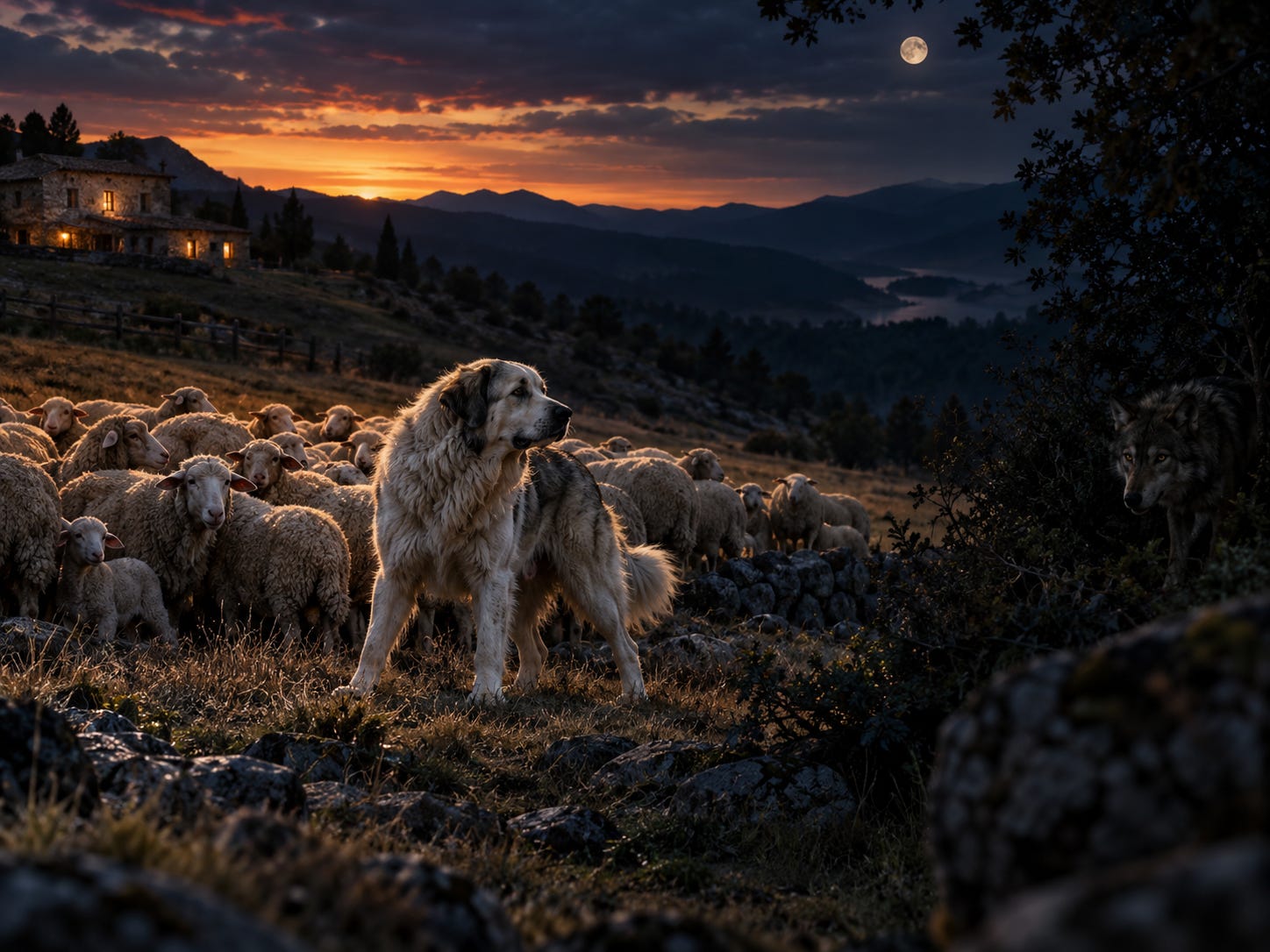
Do the sheep know that the dogs are there to protect them? Probably not. Think about the world from the perspective of the sheep. The sheepdog is loud. It barks, runs toward the flock, gets in their way, forces them to change direction, and chases them away from places they want to go. From the sheep’s perspective, the dog may very well be the most annoying creature in the pasture.
The wolf, on the other hand, may appear far less threatening. It does not bark instructions. It does not impose boundaries. It does not force the sheep back toward safety. It does not tell them where they may or may not wander. It simply waits.
If the sheep could vote, I sometimes wonder whether they might vote to get rid of the dog. That simple image reveals something profound about human nature. We are often tempted to judge everything by how it makes us feel in the moment. The thing that restricts us feels hostile. The thing that leaves us alone feels friendly. The boundary feels oppressive. The absence of a boundary feels liberating.
But protection does not always feel like protection. A toddler may become angry when his father grabs his arm and prevents him from running into the street. The child experiences restraint. The father experiences rescue. The difference between the two is not love. It is knowledge. The child sees the road. The father sees the truck.
That pattern repeats itself throughout life. A teenager sees the curfew while the parent sees the danger. An employee sees a frustrating rule while an experienced leader may remember the catastrophe that caused the rule to exist in the first place. A citizen sees an old institution and assumes it is outdated, while a student of history may recognize centuries of painful lessons embedded within it.
And sometimes we encounter moral commandments that appear to stand between us and what we desire. We see the fence. God sees what lies beyond it. There is a modern tendency to define freedom as the absence of restriction. By that definition, the freest person is the one who can do whatever he wants whenever he wants to do it. But that is not how freedom actually works. True freedom is not simply the ability to choose. It is the ability to preserve your capacity to continue choosing.
A person may freely choose to use an addictive drug, but over time the drug can begin choosing for him. A person may freely purchase everything that eventually buries him in debt, but sooner or later his payments dictate where he lives, what work he can leave, what risks he can take, and what opportunities he can pursue.
A society may remove moral boundaries in the name of liberation only to discover that the consequences of those decisions create new forms of dependence, instability, and control. Not every fence is a prison. Some fences keep the wolves out. The difficulty is that wolves rarely introduce themselves honestly.
Evil does not usually walk through the gate carrying a sign announcing its intentions. It often arrives dressed in more attractive language. It may call itself compassion, freedom, convenience, progress, justice, self-expression, or harmless experimentation. The danger is not necessarily in those words themselves. Many good things can rightly be described by them. The danger is assuming that because something carries a noble label, it must therefore produce a noble outcome.
The temptation in the Garden of Eden did not begin with a declaration of war against Adam and Eve. It began with a question: “Hath God said?” That question has echoed throughout human history. Did God really say that? Does that standard really matter anymore? Is that tradition really necessary? Why should anyone tell you what you cannot do? Why should you accept limits created by people who lived generations before you?
Those are not always illegitimate questions. Traditions should be examined. Institutions should be held accountable. Human beings are fallible, and age alone does not make an idea wise. But age alone does not make an idea foolish either. Sometimes what appears to be an outdated restriction is accumulated wisdom. Civilization is filled with boundaries erected beside cliffs that later generations forgot were there. Once we forget the cliff, the fence begins to look absurd.
This is one reason the people who care most deeply about us will sometimes tell us things we do not want to hear. Parents do this. Friends do this. Mentors do this. Pastors do this. A true friend is not merely someone who celebrates every decision you make. Sometimes friendship requires enough courage to say, “I think you are making a mistake.”
That person may risk the relationship by telling you the truth. Meanwhile, someone who cares nothing about your future may happily affirm whatever gives you immediate pleasure. Approval is cheap. Love is expensive. Love sometimes requires confrontation.
Of course, this principle can be abused. Not every critic is wise. Not every authority figure deserves obedience. Parents can make mistakes. Governments can overreach. Institutions can become corrupt. Traditions can preserve injustice as easily as they can preserve wisdom. The answer is not blind obedience. The answer is discernment, and discernment requires skepticism in both directions.
We should question authority when necessary, but we should also question the person telling us that every authority is our enemy. We should examine traditions, but we should also examine the motives and assumptions of those demanding that every tradition be discarded. We should test boundaries, but before removing them, we should understand why they were erected.
Wisdom does not merely ask, “Who is stopping me?” Wisdom asks, “What are they trying to stop me from encountering?” This matters not only in our personal lives but in civilization itself. Every generation inherits institutions it did not create: marriage, family, churches, constitutional government, private property, free enterprise, due process, freedom of speech, separation of powers, local communities, civic organizations, and moral expectations surrounding honesty, fidelity, work, responsibility, and self-restraint.
None of these institutions are perfect because human beings are not perfect. But there is a dangerous arrogance in assuming that because we did not build the fence, the fence must serve no purpose.
The American Founders understood something essential about liberty: freedom requires virtue. John Adams famously observed that the Constitution was made for “a moral and religious people.” The principle behind that statement is simple. A free society depends heavily upon people who are capable of governing themselves.
When individuals cannot exercise self-restraint, someone eventually has to restrain them. When families collapse, government is asked to absorb responsibilities once handled closer to home. When personal responsibility disappears, institutions must absorb the consequences. When virtue becomes optional, regulation often becomes mandatory.
That is one of the great ironies of radical liberation. The destruction of every moral boundary does not necessarily produce greater freedom. Sometimes it produces conditions that require greater external control. Self-government begins with governing the self. Perhaps this is why the sheepdog so often looks like the enemy.
The person warning about consequences is accused of spreading fear. The parent establishing boundaries is called controlling. The preacher teaching ancient moral standards is called judgmental. The citizen defending constitutional limits is accused of standing in the way of progress. The person who asks whether rapid cultural change might carry unforeseen consequences is treated as though the question itself is evidence of bad character.
But disagreement is not hatred. Boundaries are not automatically oppression. Warnings are not violence. And discomfort is not necessarily harm. Sometimes discomfort is the feeling of someone pulling you away from a cliff.
Still, not every barking dog is a sheepdog. Some people manipulate through fear. Some leaders use tradition as an excuse for power. Some institutions deserve reform. Some boundaries deserve to be moved. The question is not whether the dog is barking. The question is what the dog is barking at.
That distinction requires wisdom. Christ taught His followers to be “wise as serpents, and harmless as doves.” Wisdom looks beyond appearances. It asks who benefits from a particular idea, where a particular road leads, what happens if everyone follows the principle for twenty years, and what human weakness a particular boundary was designed to restrain.
Those are far better questions than simply asking whether a rule makes us uncomfortable. This also creates a responsibility for those of us who inherited the fences. We cannot merely tell the next generation, “Because I said so.” We must explain why.
If we believe marriage matters, we should explain why. If we believe faith matters, we should explain why. If we believe free speech matters, we should explain why. If we believe capitalism, property rights, constitutional government, personal responsibility, and limited government matter, we should explain the realities of human nature those principles were designed to address.
If we believe God’s commandments protect human happiness, then we should teach the principle behind the commandment, not merely repeat the prohibition. A generation that understands only the rule will eventually resent the rule. A generation that understands the reason may learn to defend it. Our children should not inherit fences without maps. They should know where the cliffs are.
So when something stands between you and what you want, resist the instinct to immediately declare it your enemy. Look farther down the road. Ask whether the restriction exists because someone understands a danger you cannot yet see. Ask whether the old institution you are preparing to dismantle solved a problem you have never personally experienced. Ask whether the person saying “no” might actually care enough about you to risk your anger.
And perhaps most importantly, ask whether the voice promising unlimited freedom has told you the entire price. Because the sheepdog and the wolf can both disrupt your peace. The difference is that one is willing to disturb you in order to save you. The other wants you comfortable until it is too late.
The dog may bark. The fence may constrain. The warning may irritate. The commandment may require sacrifice. But before we tear down every boundary standing between us and our desires, we should make absolutely certain we understand what was standing on the other side. Sometimes the thing that feels like an obstacle is actually standing guard. And sometimes the thing promising liberation is simply waiting for the gate to open.
“Before tearing down a fence because it limits your freedom, make sure you know what it was built to keep out.” — Alma Ohene-Opare