


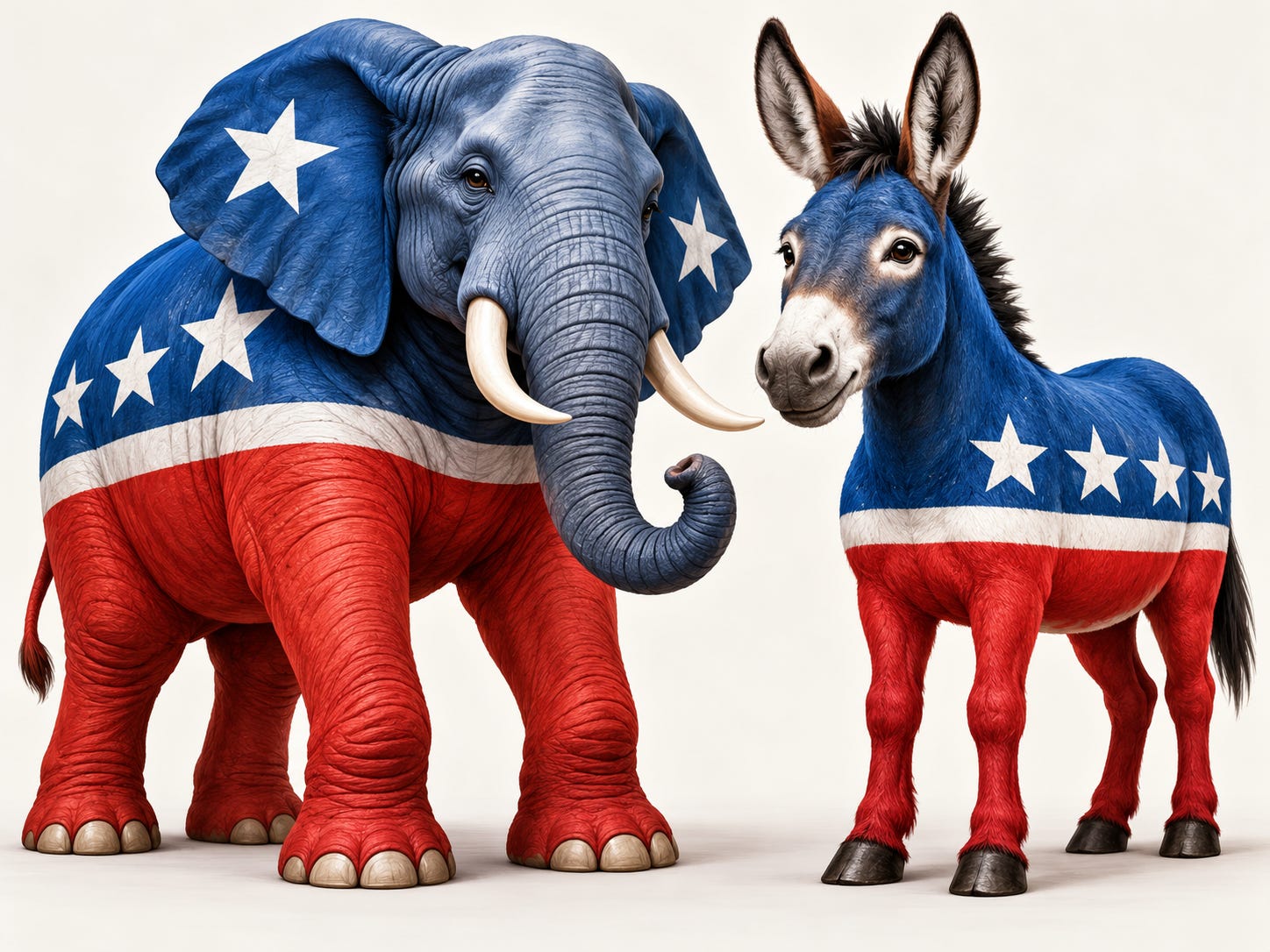
One of the most intellectually lazy conclusions in modern American political discourse is the assertion that both political parties are essentially the same. We hear it whenever a politician is caught in a scandal, whenever a campaign promise is broken, or whenever someone discovers that a public official has failed to live up to the values they profess. The conclusion is almost predictable: Both sides are corrupt. Both sides are hypocritical. Both sides are equally bad.
I understand the frustration behind these statements. I share some of it. There are dishonest politicians in both parties. There are opportunists who would abandon their convictions for political survival, and there are individuals whose professed principles seem to evaporate the moment those principles become inconvenient. But I reject the conclusion that these failures make the parties morally or philosophically equivalent.
To properly evaluate a political movement, we must distinguish between the imperfections of its members and the principles upon which the movement is built. These are not the same thing, and confusing them can lead us to abandon good principles simply because imperfect people have failed to uphold them.
I am a conservative because I believe in the foundational principles of conservatism, not because I believe every conservative politician is virtuous. My political convictions are not anchored to the personalities who happen to represent them at any given moment. They are anchored to a philosophy of human nature, liberty, personal responsibility, limited government, and the enduring truths upon which the American experiment was founded. That distinction matters enormously.
A Flawed Messenger Does Not Necessarily Invalidate the Message
Consider a church whose foundational teachings emphasize honesty, charity, fidelity, forgiveness, and service. Suppose a prominent member of that church is discovered to have committed fraud. Would that individual’s misconduct prove that honesty and charity are fraudulent principles? Of course not. It would establish that the individual failed to live according to the principles he professed.
In fact, the very existence of those principles provides the moral framework by which his conduct can be condemned.
Now consider a different organization whose foundational philosophy explicitly justifies deception, exploitation, and the subordination of individual rights to the ambitions of its leadership. Suppose several members of that organization are remarkably kind, generous, and compassionate people. Would their personal virtue redeem the organization’s destructive philosophy? Again, of course not.
This reveals an important distinction that is often overlooked in our political debates: Good principles are not invalidated by bad people, and bad principles are not redeemed by good people.
We understand this in nearly every other area of life. A physician who violates medical ethics does not render medical ethics worthless. A judge who accepts a bribe does not invalidate the principle of impartial justice. A police officer who abuses his authority does not prove that the rule of law is inherently unjust. Why, then, do we abandon this reasoning when evaluating political parties?
The answer, I suspect, is that judging personalities is easier than examining philosophies. Personal misconduct is visible, emotional, and frequently sensational. Foundational principles demand considerably more intellectual effort to understand and evaluate.
But principles ultimately matter because they determine what an organization considers legitimate, what conduct it rewards, what goals it pursues, and what it is willing to sacrifice in pursuit of those goals.
There is, however, an important qualification. A movement cannot indefinitely excuse widespread misconduct by pointing to beautiful principles it consistently refuses to practice. At some point, repeated institutional behavior becomes evidence of the organization’s actual operating philosophy.
An organization must therefore be evaluated by its professed ideals, the soundness of those ideals, and its demonstrated commitment to them. That is a much more serious standard than counting scandals and declaring a tie.
The Fundamental Divide Is Philosophical
My conservatism begins with a particular understanding of human nature.
I believe human beings possess inherent dignity, moral agency, individual ambitions, diverse talents, competing interests, and an imperfect nature that cannot be eliminated through legislation. I believe people generally respond to incentives, that responsibility is inseparable from freedom, and that concentrated power presents an enduring danger because those who exercise it are subject to the same human weaknesses as everyone else.
These convictions help explain my preference for limited constitutional government, private property, free enterprise, voluntary association, religious liberty, and equality before the law. They are not merely political preferences. They flow from a fundamental understanding of what human beings are and what government ought to be.
Conservatism, at its best, does not require humanity to become something it has never been. It attempts to establish institutions that account for human imperfection while preserving the freedom through which human beings can flourish.
This is why I view the American founding as such an extraordinary intellectual achievement. The Founders did not presume that virtuous leaders would always govern the nation. They constructed a system of divided powers, checks and balances, federalism, and enumerated rights precisely because they understood the danger of entrusting too much authority to fallible human beings.
The Constitution was not built on the assumption that good people would always be in charge. It was built, in significant part, to constrain what bad people could do when they were. That is a profoundly important distinction.
My fundamental objection to certain progressive and socialist philosophies is that I believe they too often underestimate these enduring realities of human nature.
To be clear, progressivism, democratic liberalism, and socialism are not interchangeable philosophies. Many Democrats support private enterprise, constitutional protections, and market competition. Some progressive reforms have pursued legitimate goals and produced valuable results. And government intervention is not automatically evidence of tyranny.
But there is a strand of modern progressive thought that increasingly treats disparities in outcomes as evidence of structural injustice requiring political correction. From that premise, it becomes tempting to assign government an ever-expanding responsibility for engineering social and economic results.
This is where my philosophical objection begins. When equality of opportunity is gradually displaced by the expectation of equality of outcomes, individual freedom can become an obstacle to the desired result.
After all, people are different. They possess different interests, make different decisions, assume different risks, and prioritize different goals. Even if every individual began with identical resources and opportunities, their choices would eventually produce different outcomes.
What happens when those differences are deemed politically unacceptable? How does a government guarantee increasingly uniform outcomes among people who insist on making different choices? At some point, it must either tolerate the differences or increasingly constrain the choices that produce them.
That is the fundamental danger I see in political philosophies that place engineered equality above individual liberty. The more a political system attempts to guarantee outcomes, the more power it must acquire over the decisions that produce those outcomes.
This is not an argument against compassion, reasonable regulation, or a basic social safety net. Nor does it establish that every progressive policy necessarily produces coercion. It is an argument for recognizing the tension between expansive government-directed social objectives and the liberty of individuals to pursue their own objectives.
A policy can sound compassionate in its aspirations and still become coercive in its implementation. Good intentions do not exempt a philosophy from the consequences of its methods.
Why Both Parties Are Not the Same to Me
When I examine the Republican and Democratic parties, I am not simply asking which party has the nicer politicians or which one has accumulated fewer scandals.
I am asking which political philosophy more closely aligns with my understanding of human nature, constitutional government, and the proper relationship between individuals and the state.
The parties’ own platforms demonstrate that they emphasize different approaches. The Republican platform of 2024 explicitly champions lower taxes, reduced regulation, religious liberty, constitutional freedoms, and individual liberties. The Democratic platform of that year emphasizes government investment, labor protections, expanded public programs, and economic policies designed to address inequality and strengthen the middle class.
These differences are meaningful, even though neither platform perfectly embodies its party’s historical philosophy and neither party consistently practices what it preaches.
I find the classical conservative commitment to individual liberty, personal responsibility, and restraints on government power more compelling than the progressive tendency to look toward collective political solutions for an expanding range of social problems. That does not mean every Republican policy advances liberty or every Democratic policy undermines it.
Indeed, Republicans should be challenged when they champion tariffs that restrict economic freedom, expand government spending without restraint, attempt to regulate lawful personal behavior unnecessarily, or excuse executive overreach simply because a Republican occupies the White House.
I cannot credibly condemn concentrated government power when Democrats wield it and celebrate the same concentration of power when Republicans do. The principle must remain superior to the party.
Similarly, I can acknowledge the sincerity and virtue of Democrats who support their party because they genuinely believe its policies will improve lives. A person may be compassionate, intelligent, patriotic, and entirely mistaken about the consequences of a political philosophy. I do not need to question someone’s character to question their conclusions.
And I do not need to deny the accomplishments of an ideological opponent to remain convinced that my own principles offer a better foundation for government. This is precisely why I reject the idea that political disagreement is merely a competition between good and bad people.
It is often a competition between fundamentally different understandings of freedom, fairness, justice, responsibility, and human flourishing.
Principles Must Be Tested Against Reality
There is another danger worth acknowledging. It is possible for people to become so attached to the stated ideals of their movement that they become blind to its actual behavior.
This is why a defensible political philosophy must be more than a collection of attractive declarations. It must survive scrutiny.
If conservatives claim to believe in fiscal responsibility, we should examine whether conservative governance actually restrains spending and debt. If we claim to believe in freedom of speech, we must defend that freedom even when the speaker expresses ideas we find offensive. If we believe in the rule of law, we must insist that the law apply equally to political allies and political opponents.
Principles that disappear under the pressure of political convenience were never serving as principles. They were serving as slogans.
Likewise, progressive policies should be evaluated not merely by their stated intentions but by their actual effects on incentives, opportunity, economic prosperity, social trust, and individual freedom.
Does a policy genuinely help the people it claims to serve? Does it create long-term independence or deepen dependence? Does it expand opportunity or merely redistribute existing rewards? Does it solve a problem, or does it create new problems requiring even more government intervention?
These are legitimate questions, and they deserve empirical answers rather than moral accusations against those who ask them. The real test of any political philosophy is not whether it can describe a desirable destination. Almost anyone can do that.
The test is whether its proposed path is consistent with human nature, preserves fundamental rights, and produces sustainable improvements in the lives of real people.
History offers enough examples of noble political aspirations producing disastrous consequences to warrant considerable humility whenever someone promises to perfect society through concentrated political authority.
It also offers examples of market failures, private abuses, and injustices that required effective government action. A serious conservative should be willing to learn from those examples rather than pretend that markets and voluntary institutions are infallible.
The objective is not ideological purity detached from reality. The objective is a philosophy sufficiently grounded in truth that reality does not have to be denied to preserve it.
My Loyalty Is to Principles, Not a Political Party
Ultimately, my conservatism is not dependent upon the Republican Party.
If the Republican Party abandoned the principles of constitutional restraint, individual liberty, economic opportunity, personal responsibility, and the rule of law, I would have no intellectual obligation to follow it into that abandonment.
My loyalty is to the principles, not the institution that claims to represent them. This is why I find it unpersuasive when someone attempts to undermine my convictions by identifying a Republican politician who has acted dishonorably.
If that politician violated the principles I believe in, then we agree that the conduct deserves condemnation. But that is an argument for holding the politician accountable, not for surrendering the principles.
Nor am I persuaded when someone points to a particularly admirable progressive or Democratic politician as evidence that the broader ideological disagreements are inconsequential.
I can admire someone’s character while opposing their political philosophy. I can condemn someone’s misconduct while affirming a principle they failed to uphold. That is not hypocrisy. It is intellectual consistency.
America’s political future will not be secured by cultivating blind loyalty to parties or personalities. Nor will it be secured by the fashionable cynicism that treats every political movement as equally corrupt and every philosophical distinction as meaningless.
We need citizens willing to do the more demanding work of examining first principles, evaluating consequences, challenging their own assumptions, and insisting that public officials live according to the standards they profess.
We need people who understand that a flawed representative does not automatically make a principle defective, but that repeated betrayals of principle must never be excused simply because they come from our preferred side.
And above all, we must recover the conviction that truth exists independently of our political allegiances. I am a conservative not because I believe conservatives are incapable of wrongdoing, but because I believe the principles of conservatism, properly understood and faithfully applied, offer the strongest foundation for a free, prosperous, and morally responsible society.
I will defend those principles when Republicans honor them, and I will defend them when Republicans violate them. Because a political philosophy worthy of my allegiance must be capable of correcting its own adherents.
That is what separates conviction from tribalism. And that is why, when someone tells me both parties are the same, my answer is simple: You are measuring the wrong thing. Do not merely ask whether the people carrying the banner are flawed. Ask whether the banner itself is worth carrying.
“A principle is not made false by the failures of those who profess it, nor is a false principle made true by the virtues of those who embrace it. Judge the tree by its nature, its cultivation, and ultimately, by the fruit it bears.” — Alma Ohene-Opare
Thank you!!! I love how you clearly spell all of us out. I'm going to go read it again!