


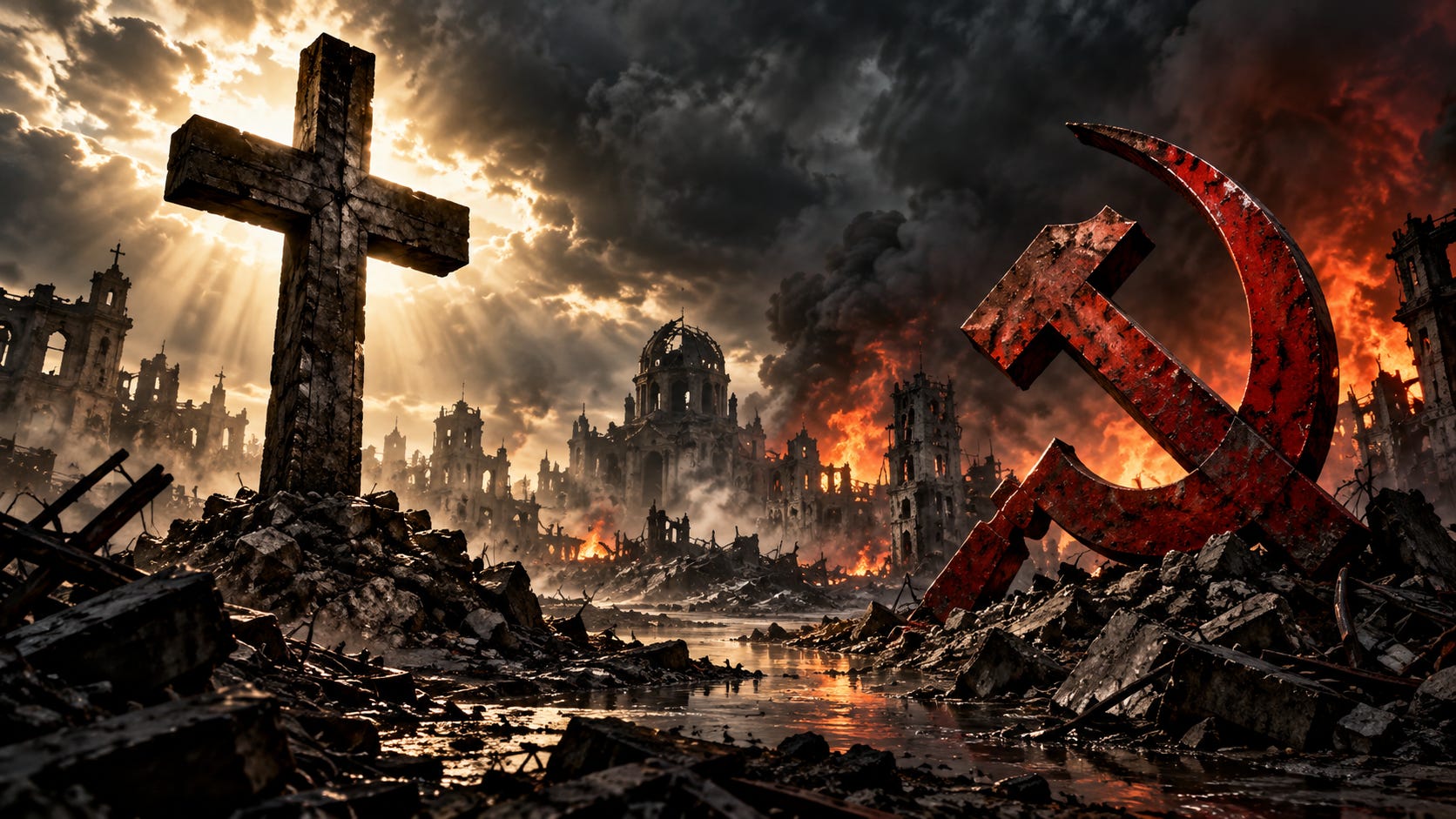
When atrocities are committed in the name of God, critics blame religion. But history reveals an uncomfortable truth: removing God from society has never removed mankind’s capacity for evil.
I recently watched a disturbing BBC report about a self-proclaimed pastor in Kenya named Paul Mackenzie, who stands accused of orchestrating one of the most horrifying religious cult tragedies in recent memory. According to prosecutors, Mackenzie persuaded families to retreat into a remote forest, where parents were instructed to starve their children and eventually themselves so they could meet Jesus.
More than 400 bodies were discovered in the Shakahola forest. Mackenzie and 29 others have faced murder charges concerning the deaths of 191 children. They have denied the allegations.
As a father of four, I find the thought of parents deliberately starving their own children almost impossible to comprehend. The idea that someone could invoke the name of Jesus Christ to convince a mother or father to participate in such cruelty is particularly disturbing. There is no justification for such wickedness. If the allegations are proven, those responsible deserve to face the full consequences of the law.
But as I read the comments beneath the video, I noticed something else.
Comment after comment blamed religion.
“Religion is poison.”
“Religion has killed more people than anything else.”
“The world would be better off without religion.”
These are familiar assertions, particularly among some atheists and critics of organized religion. The argument is that religious belief has been responsible for so much human suffering that humanity would be better served by abandoning it altogether.
I understand the emotional appeal of that argument, especially when confronted with such unimaginable cruelty. But I believe it contains a profound historical and philosophical error. It confuses a vehicle through which human evil can operate with the underlying source of human evil itself.
And more importantly, it frequently smuggles in another proposition that deserves far greater scrutiny: that a humanity liberated from religion would somehow become a more compassionate, peaceful, and morally responsible civilization. History gives us very little reason to accept that proposition.
Let Us First Acknowledge Religion’s Dark History
Defending religion does not require defending everything done in its name. Religious inquisitions, forced conversions, sectarian violence, and persecution of religious minorities all occupy uncomfortable chapters of human history. Religious authorities have sometimes aligned themselves with oppressive governments, justified conquest, enabled slavery, and brutalized vulnerable populations.
Some religious movements have elevated institutional power above human dignity. Others have used promises of salvation and threats of damnation to manipulate followers into surrendering their freedom, property, and even their lives. These are not imaginary criticisms. They are historical realities.
Nor can every atrocity committed under a religious banner simply be dismissed as having nothing to do with religion. Religious teachings, institutions, and leaders can genuinely contribute to the conditions that produce violence. We should acknowledge that without equivocation.
But acknowledging that religion has been used to commit atrocities is not the same as establishing that religion is uniquely responsible for mankind’s cruelty. And it certainly does not establish that removing religion would eliminate, or even necessarily reduce, that cruelty. To reach such a conclusion, we must examine what happens when religious authority is replaced by something else.
The Atrocities of the Godless Utopias
If religion were the primary cause of humanity’s brutality, we might reasonably expect societies that explicitly reject religion to demonstrate a substantially greater respect for human life. Unfortunately, some of the most horrifying experiments in modern history tell a different story.
Consider the Soviet Union under Joseph Stalin. The Communist state promoted official atheism, persecuted religious institutions, and sought to replace traditional religious allegiances with loyalty to the revolutionary state.
Yet religious persecution was only one dimension of its brutality. Political purges, forced labor camps, mass deportations, executions, and state policies associated with catastrophic famine devastated millions of lives.
Or consider Mao Zedong’s China, where a revolutionary project intended to transform society resulted in widespread persecution, political terror, and a disastrous famine during the Great Leap Forward.
Then there is Cambodia under the Khmer Rouge. Between 1975 and 1979, nearly two million Cambodians died under a revolutionary Communist regime determined to create a radically transformed agrarian society.
The regime persecuted Buddhist monks, attacked traditional religious institutions, uprooted families, abolished established social structures, and subjected ordinary citizens to forced labor, starvation, and execution. This was not an atrocity committed in the name of Jesus Christ, Allah, or the Buddha. It was committed in pursuit of a political utopia.
Of course, it would be intellectually dishonest to conclude from these examples that atheism itself inevitably produces tyranny. Millions of atheists live peaceful, compassionate, morally responsible lives. Many have courageously resisted oppression.
But that is precisely the point. If we recognize that the crimes of Stalin, Mao, and Pol Pot do not automatically indict every atheist, why do we so readily accept that the crimes of a murderous pastor indict everyone who believes in God? The standard of moral responsibility should not change depending on whether the perpetrator invokes heaven or revolution.
The Human Appetite for Absolute Authority
I believe the deeper problem lies in something far more universal than religious belief. Human beings have an extraordinary capacity to organize themselves around ideas, causes, personalities, and institutions. That capacity has allowed us to build civilizations, advance science, establish governments, and create remarkable prosperity.
But the same capacity can become destructive when people surrender their moral judgment to an authority they believe cannot be questioned. Sometimes that authority is a religious leader claiming to speak for God.Sometimes it is a revolutionary promising equality. Sometimes it is a dictator promising national restoration. Sometimes it is a political movement promising liberation from oppression.
The language changes, but the underlying temptation remains remarkably consistent. Convince people that your cause represents the highest possible good, persuade them that dissent threatens that good, and eventually almost any cruelty can be rationalized as necessary.
A person who believes that starving a child will guarantee eternal salvation has surrendered moral judgment to a destructive authority. So has the revolutionary who believes that starving a population is an acceptable price for achieving a classless society.
The objectives are different. The rationalizations are different. But both involve subordinating real human beings to an allegedly greater purpose. The most dangerous moment in any ideology comes when its followers conclude that the righteousness of their objective excuses the wickedness of their methods. Religion does not have a monopoly on that temptation.
Removing God Does Not Remove the Need for Gods
One of the most fascinating features of human nature is our tendency to organize life around something we consider ultimate. For religious believers, that may be God. For others, it may be the state, the nation, a political philosophy, a charismatic leader, scientific progress, or a vision of social perfection.
These commitments are not all equivalent, nor should ordinary secular convictions be confused with religious worship. But any worldview can become dangerously dogmatic when its adherents place it beyond criticism. When a society rejects religious authority, its desire for meaning, belonging, moral certainty, and collective purpose does not simply disappear.
Those impulses can attach themselves to other institutions and ideologies. And when political power becomes the highest moral authority, the consequences can be especially dangerous. The state possesses something that most religious organizations do not: a legally recognized monopoly on coercive force.
A corrupt religious leader can manipulate hundreds or thousands. An unchecked totalitarian government can impose its will upon millions. This does not make religion harmless or government inherently wicked. It reminds us that concentrated power becomes especially dangerous when it is insulated from accountability.
The American constitutional tradition recognizes this danger. Religious liberty, freedom of conscience, freedom of speech, and limitations on government power are not merely procedural conveniences. They are safeguards against humanity’s tendency to confuse conviction with entitlement to control others.
A society does not become free simply by removing religious influence. It becomes free when people and institutions are prevented from exercising unlimited power over their fellow human beings.
What About the Good Religion Has Done?
There is another problem with the sweeping indictment of religion: it frequently counts religion’s historical sins while overlooking its contributions. Across centuries, religious communities have established hospitals, schools, orphanages, charitable organizations, shelters, universities, and humanitarian networks.
Faith has motivated countless individuals to care for the sick, feed the hungry, shelter strangers, resist oppression, and sacrifice their personal comfort for the welfare of others. Religious convictions helped inspire important abolitionist movements and campaigns for civil rights, even as other religious figures used their faith to defend slavery and segregation. That complicated history matters.
If we are going to evaluate religion by the consequences of religious belief, intellectual consistency requires us to consider both its failures and its achievements. We cannot count every atrocity committed beneath a religious banner while ignoring every act of extraordinary compassion motivated by faith.
Nor should we overlook the substantial humanitarian contributions of secular individuals and organizations. The relevant question is not whether religious people are capable of goodness and atheists are capable of evil, or vice versa. Both propositions are obviously true.
The question is whether an ideology teaches people to recognize the inherent worth of others, restrain their own appetites for power, and remain accountable for the consequences of their actions. Those are the standards by which we should evaluate every worldview.
The God I Believe In Does Not Require the Death of Innocents
As a Christian, I cannot discuss the tragedy in Kenya without addressing the grotesque distortion of faith at its center. Jesus Christ taught that children were precious. He welcomed them, blessed them, and warned against causing little ones to stumble.
He taught His followers to love their neighbors, care for the vulnerable, and serve those in need. A man who allegedly persuades parents to starve their children in order to meet Jesus has not demonstrated the compassionate teachings of Christ. He has invoked religious language to justify conduct fundamentally opposed to those teachings.
That distinction matters, although it does not absolve religious communities of their responsibility to recognize and confront dangerous leaders. Faith must never become an excuse to abandon reason, conscience, personal responsibility, or the protection of the innocent.
If anything, sincere faith should impose greater moral obligations upon believers. Christ taught that we would know people by their fruits. That instruction invites us to examine conduct rather than merely accept claims of spiritual authority.
When a leader demands cruelty, secrecy, unquestioning obedience, or the abandonment of our most basic responsibilities, we should judge those demands accordingly.
The Problem Has Always Been Us
The tragedy in Kenya deserves justice. It deserves mourning. And it deserves serious reflection about how manipulation, isolation, and unquestioned authority can lead ordinary people toward unimaginable acts.
But it should not become an excuse for intellectually lazy conclusions about billions of people who practice their faith peacefully. Humanity has committed atrocities in the name of religion, race, empire, class, nationalism, political revolution, and countless other causes. The common denominator is not God. It is us.
Our capacity for pride, cruelty, tribalism, fear, resentment, self-righteousness, and the pursuit of power is not confined to any particular theology or political philosophy. That is why I believe the solution is not to wage war against religion but to defend the principles that protect human dignity: liberty of conscience, individual responsibility, the rule of law, moral accountability, and the freedom to challenge those who claim authority over us.
Religious believers must be willing to confront abuses committed in the name of their faith. Secular critics must be willing to apply the same scrutiny to movements that reject religion. Neither group should demand moral immunity for its own worldview.
We should be skeptical of anyone who promises that eliminating one set of beliefs will finally cure humanity of evil. Because the greatest danger is not merely what human beings believe. It is what we become willing to do to other human beings when we convince ourselves that our beliefs place us beyond reproach.
“Humanity’s greatest atrocities begin not when people believe in God or reject Him, but when they begin to believe that their convictions excuse their cruelty.” — Alma Ohene-Opare