



Some relationships begin to fracture long before anyone stops speaking. The conversations continue, but the meanings have drifted apart. We hear familiar words and assume we understand them. Then we judge, defend, and withdraw, never discovering that we have been answering statements the other person did not intend.
As a teenager, I sometimes struggled to communicate with my mother and resorted to writing letters and leaving them on her bed. I wanted to be understood. Years later, I recognize how universal that longing is. Beneath many heated arguments sits someone trying to say, “Please hear what I actually mean.”
I wrote From Babel to Coherence as a fellow learner. I have participated in the very patterns I describe, and I am still practicing the discipline of understanding before judgment. The problem I call Semantic Babel is painfully ordinary: we retain a shared vocabulary while losing shared meaning.
In the biblical account of Babel, people could no longer understand one another because their languages changed. Our modern experience can be harder to detect. We speak the same language, use the same words, and still leave the conversation believing we have encountered an enemy.
One Word Can Divide a Family
In the guidebook, fictional father and daughter Daniel and Maya illustrate this problem. Daniel remembers the little girl who trusted him to explain thunderstorms and fix her bicycle. Maya has grown into a young woman with her own experiences and convictions. Their conversations become increasingly difficult.
Then Maya tells him she does not feel safe talking to him.
Daniel hears an accusation that he poses a physical threat. He remembers years spent protecting her and reacts with disbelief. Maya means that she fears being dismissed or shut down when she expresses her thoughts. His defensive response reinforces her concern; her response reinforces his sense of being unfairly accused.
Neither has checked the dictionary the other is using.
Words such as safe, respect, harm, and love carry histories. We learn them within families, churches, schools, and friendships. Their meanings become so familiar that another person’s different usage can feel like dishonesty or betrayal. We assume our interpretation is obvious because it is obvious to us.
Every relationship depends on what I call a Semantic Commons: enough shared meaning to reason together. We need to understand what someone is asking for when they request respect, and what they are describing when they report harm. Without that foundation, even sincere conversations become unstable.
Some words bear particular weight. A parent may hear controlling as a rejection of years of loving guidance. An adult child may hear ungrateful as a refusal to recognize independence. Those reactions deserve examination because they can arrive before we have understood the sentence.
How Misunderstanding Becomes Estrangement
The guidebook describes a four-stage Babel Cascade. First, meanings fracture without either person noticing. Judgments follow. Then people assign motives to explain what they think they heard. Finally, separation begins to feel safer than communication.
A disagreement about a decision becomes a declaration about character. “I think this choice is unwise” gets interpreted as “You do not respect my adulthood.” A request for space gets interpreted as “You no longer care about this family.” Soon, each person is defending against an imagined intention.
This is where moral responsibility enters the conversation. We are accountable for our words and actions, including the claims we make about another person’s motives. A suspicion may warrant a question. It does not automatically warrant a verdict. True integrity requires care in how we represent our neighbors, especially when emotions make careless accusations tempting.
We can make that responsibility practical by describing behavior before assigning intention. “You interrupted me three times, and I struggled to finish my thought” gives someone something concrete to address. “You only want to control me” claims knowledge of an inner motive that may never have been established.
We also need to identify the layer of disagreement. Are we debating a definition, whether it applies, what happened, whether the conduct was right, or what should happen next? A single argument can contain all five questions. Separating them helps us locate the actual dispute.
That discipline matters beyond our homes. Americans can disagree vigorously about policy while sharing commitments to liberty, dignity, and responsibility. But we must clarify those commitments before invoking them as weapons. Self-government requires citizens who can examine an opposing argument accurately enough to challenge it honestly.
Every Debate Must Earn the Right to Begin
The central practice in the guidebook is representation before rebuttal. Before challenging someone’s position, explain it in language that person recognizes as accurate. Ask what you have missed, allow correction, and keep listening until you can describe the view faithfully.
This does not diminish conviction. It gives conviction an honest target. I remain free to conclude that an argument is mistaken, unsupported, or morally wrong. Understanding ensures that my conclusion addresses the position actually held.
The Right-to-Debate Test asks both people to establish four things: the other’s position, the meaning of important terms, their shared ground, and the precise point where agreement ends. Once those are clear, the remaining disagreement becomes easier to examine.
Daniel and Maya begin rebuilding through a shared dictionary. Each explains what important words mean, offers examples, and identifies what does not fit. The exercise also exposes their own inconsistencies. Daniel discovers that his objection to being corrected in front of others involved pride he had quietly folded into his definition of respect.
That moment matters. A method for understanding others must also make us more honest about ourselves. We cannot demand careful language while exempting our assumptions from scrutiny.
Begin with one relationship and one word that repeatedly causes conflict. Ask for its meaning and a concrete example. Reflect the answer back before offering your own definition. If emotions rise, take a pause, name when you will return, and keep that commitment. Afterward, acknowledge any meaning you assigned too quickly.
The goal is Semantic Coherence: understanding one another’s language, assumptions, and positions well enough to communicate accurately while genuine disagreements remain. Daniel and Maya still disagree. Their progress lies in knowing what the disagreement is and refusing to invent the other’s position.
Sometimes clarity reveals a difference that requires a boundary. Threats, coercion, violence, and abuse cannot be resolved simply by improving definitions. Truthful understanding may support reconciliation or necessary distance.
For relationships being damaged by preventable misunderstanding, however, we have work within reach. We can ask an honest question, revise a careless accusation, and represent a loved one fairly. The bridge begins with the humility to discover what a word means before deciding what it proves.
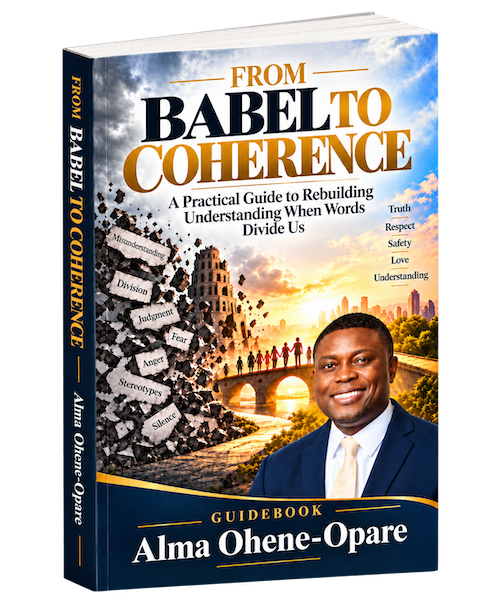
This Thanksgiving, give your family something that can last beyond the holiday: a better way to understand one another. My guidebook, From Babel to Coherence: A Practical Guide to Rebuilding Understanding When Words Divide Us, releases November 10 in Kindle ebook and paperback, giving you time to read it before gathering around the Thanksgiving table.
With conversation prep sheets, the Right-to-Debate Checklist, and tools for building your own Semantic Dictionary, it offers practical steps for approaching difficult conversations without surrendering your convictions.
Visit SemanticBabel.com to preorder the guidebook and take the free assessment, where you can reflect on your communication, evaluate a relationship, and begin practicing the principles. Before another disagreement creates distance, discover what becomes possible when we learn to understand each other accurately.
“Before you decide that someone has rejected your values, make sure you have understood their words.” — Alma Ohene-Opare