


Recently a really good friend expressed to my wife and I her hesitancy to celebrate Thanksgiving. Like many who have difficulty reckoning with America’s past, she believed celebrating Thanksgiving minimizes the betrayal of Native Americans by European settlers and colonists and the subsequent atrocities committed against them pre and post the founding of America. To her, participating in this American tradition had become something of a moral dilemma. She did not have anything against the virtue of gratitude and even suggested relocating the holiday away from the darkness surrounding our country’s past.
I found this deeply unfortunate. Not because the atrocities committed against Native Americans should be ignored, but because so many God-loving and otherwise patriotic Americans had been persuaded to view a tradition of expressing gratitude for the blessings of God as somehow tantamount to a veiled endorsement of the sins of our progenitors.
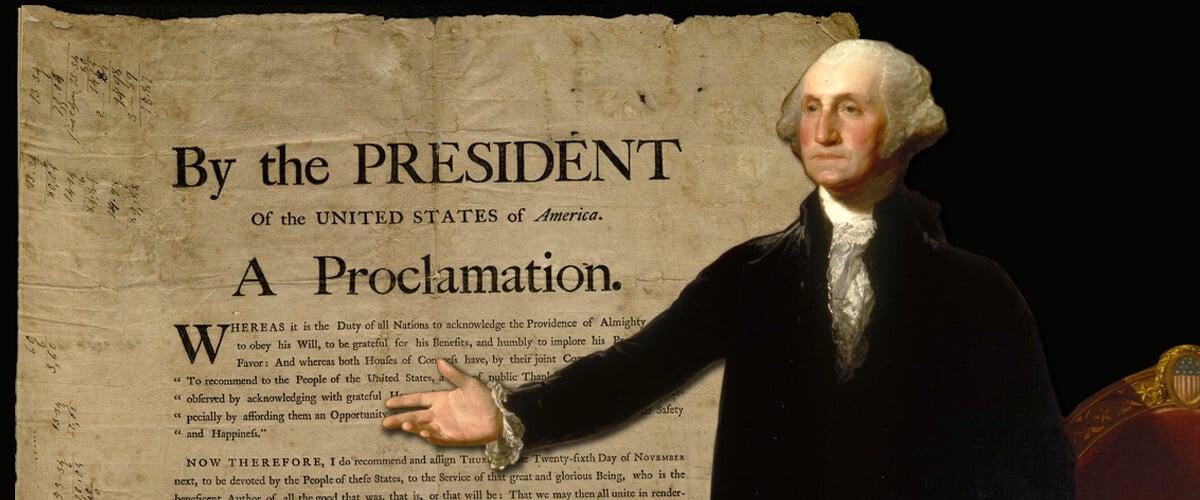
The day after my conversation with my friend, I watched a video by Pastor Josh Howerton in which he read George Washington’s original Thanksgiving Proclamation. I am grateful to Pastor Howerton for illuminating my understanding of one of our most prominent Founding Fathers and reminding me of the extraordinary spiritual heritage behind this national tradition.
What Washington actually said deserves the attention of every American.
What George Washington Actually Wanted America to Celebrate
On October 3, 1789, just months after becoming the first president of the United States, George Washington issued a proclamation designating Thursday, November 26, as a national day of thanksgiving and prayer.
He began with these extraordinary words:
Whereas it is the duty of all Nations to acknowledge the providence of Almighty God, to obey his will...
Consider the significance of that statement. The first president of the United States was declaring that nations, not merely individuals, had a moral obligation to acknowledge God, obey His will, express gratitude for His blessings, and seek His divine protection.
Furthermore, this proclamation was issued at the request of both houses of Congress. The invitation to publicly acknowledge God came from both the executive and legislative branches of our newly established constitutional republic.
Washington enumerated several reasons for which Americans ought to be grateful. Among them were the protection of divine Providence during the Revolutionary War, the establishment of constitutional government, the peace and prosperity the nation enjoyed, civil and religious liberty, and the opportunity to acquire and disseminate knowledge.
There was no declaration celebrating the conquest of Native Americans. There was no glorification of racial superiority. There was no invitation to commemorate the dispossession of another people.
The father of our country was inviting Americans to recognize the hand of God in the establishment of their nation.
Thanksgiving Was Also a Call to National Repentance
Perhaps the most remarkable portion of Washington’s proclamation, and the one that most directly challenges the prevailing narrative about Thanksgiving, is his invitation to Americans to beseech God to:
pardon our national and other transgressions
Washington also prayed that Americans would faithfully fulfill their responsibilities, that their government would administer just and constitutional laws, and that other nations would enjoy peace, prosperity, and good government.
Smithsonian Institution+1
How can anyone reasonably characterize the original purpose of Thanksgiving as an attempt to whitewash American history when the very proclamation establishing the observance explicitly called upon Americans to seek forgiveness for their national transgressions?
Washington did not demand that Americans proclaim their innocence. He invited them to acknowledge their dependence upon God.
We should not overlook the historical irony that Washington himself enslaved human beings. America was far from living up to its founding ideals. Yet the principles contained in his proclamation transcend the imperfections of the man who issued it.
The Christian understanding of gratitude has never required moral perfection on the part of the recipient. If perfection were a prerequisite for thanksgiving, none of us would ever qualify to offer a prayer of gratitude.
America’s first presidential Thanksgiving proclamation was an invitation to both gratitude and repentance.
The Christian Roots of the American Republic
There has been a tendency in modern discourse to portray America’s founding as an almost exclusively secular intellectual endeavor. Yet the words and actions of many of our Founding Fathers reveal a considerably different picture.
In 1776, the Declaration of Independence established the philosophical foundation of our republic by affirming that human beings derive their unalienable rights from their Creator.
In his June 8, 1783, Circular to the States, Washington prayed that Americans would practice justice, mercy, charity, humility, and peace, in imitation of the divine example of Jesus Christ.
In his 1796 Farewell Address, Washington identified religion and morality as indispensable supports of political prosperity. These convictions were not unique to Washington. Religious language, biblical principles, congressional chaplains, public prayers, and proclamations of fasting and thanksgiving were features of America’s founding era.[
None of this means that every Founding Father subscribed to the same Christian theology or that America was established as a Christian theocracy. Our Constitution protects religious liberty precisely because matters of conscience should not be dictated by government.
But there is an enormous difference between establishing a national religion and establishing a nation deeply influenced by religious principles. America rejected the former without abandoning the latter.
To erase Christianity from the story of America’s founding is not to preserve historical neutrality. It is to omit an essential part of our national heritage.
Honoring Native Americans Without Abandoning Thanksgiving
The historical gathering that took place in Plymouth in 1621, involving English settlers and members of the Wampanoag nation, was a moment of cooperation following a period of tremendous hardship.
The Native Americans were not incidental characters in that story. Their knowledge, assistance, and cooperation contributed to the survival of the settlers. Their contributions deserve recognition and gratitude.
What followed in subsequent decades and centuries included broken treaties, dispossession, forced displacement, violence, and immeasurable human suffering. Many Native Americans consequently observe Thanksgiving as a day of mourning. Their historical experiences deserve to be heard and understood.
National Archives Museum+2
But the tragedies that followed the Plymouth gathering do not retroactively transform every act of cooperation into an act of betrayal. Neither do they change the expressed purpose of Washington’s proclamation nearly 170 years later.
Why should acknowledging an instance of cooperation require us to deny subsequent instances of cruelty? Conversely, why should acknowledging cruelty require us to erase instances of cooperation?
History is not an exercise in selecting only those events that reinforce our preferred narrative. We must possess the intellectual and moral maturity to recognize goodness and evil wherever they occurred.
I can be grateful for America without being grateful for every action taken by Americans. I can honor our Founding Fathers without defending all their personal conduct. I can celebrate the establishment of our constitutional republic while condemning the injustices committed under its flag.
There is no moral contradiction in doing so.
Abraham Lincoln Understood the Power of Gratitude
On October 3, 1863, exactly 74 years after Washington’s proclamation, President Abraham Lincoln issued the proclamation that established the precedent for our annual national Thanksgiving observance.
America was in the midst of a devastating Civil War. Families were mourning loved ones, slavery had divided the nation, and the future of the republic remained uncertain.
Yet Lincoln called upon Americans to express gratitude to God while acknowledging their national sins. He asked them to pray for those who were suffering and to seek divine intervention to heal the nation’s wounds.
National Archives Museum+1
Lincoln understood something we desperately need to rediscover: gratitude is not the absence of grief. It is the recognition of goodness in the presence of grief.
Thanksgiving was never reserved for a time when America had resolved all its contradictions. It was established and institutionalized at moments when America desperately needed God’s guidance.
Let Us Reclaim Thanksgiving
As an immigrant who became an American citizen, I have never regarded the blessings of America as an entitlement. I recognize the extraordinary privilege of living in a country where I can worship according to the dictates of my conscience, raise my family, pursue my dreams, speak freely, and participate in determining the future of my nation.
These blessings are worthy of thanksgiving.
This Thursday, before we carve the turkey, watch football, or gather around our dinner tables, I invite every American family to read George Washington’s original Thanksgiving Proclamation. Teach your children why our nation established this tradition. Teach them about the Pilgrims and the Wampanoag people. Teach them about America’s triumphs and its failures. Teach them that loving their country does not require believing their country is perfect.
Above all, teach them to recognize the hand of God in their lives. Pray for our nation, ask forgiveness for our transgressions, serve those who are less fortunate, and renew your commitment to preserving the blessings of liberty for future generations.
Thanksgiving is not a celebration of what America did to others. At its heart, it is an acknowledgment of what God has done for us and a reminder of what we ought to do for one another.
May we never become so consumed by the imperfections of our past that we lose the capacity to recognize the blessings of our present.
May God bless you and your family, and may God continue to bless the United States of America.
Happy Thanksgiving!
“A grateful nation need not deny its sins, and a repentant nation need not deny its blessings. True patriotism has room for both.” — Alma Ohene-Opare
So beautifully written and worthwhile truths. Thank you. I am grateful for you! Happy Thanksgiving! We CAN hold both, the good and the bad, while always pursuing the good through God!