


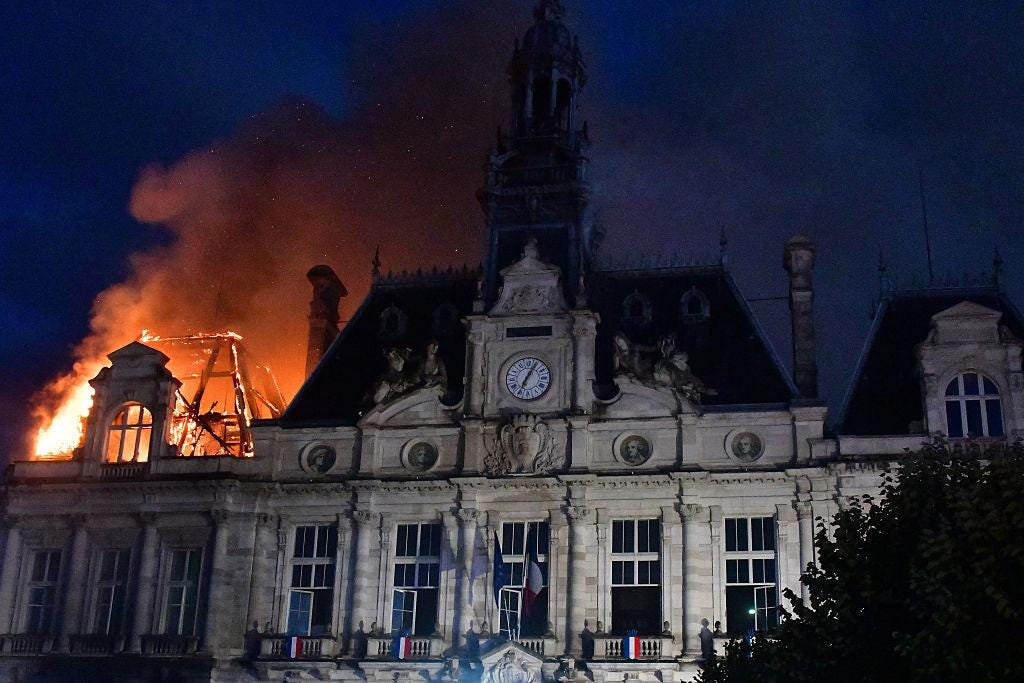
I have been watching the disturbing images emerging from France, where demonstrations over deteriorating public services and economic hardship have descended, in some places, into violence, looting, and destruction. Among the most heartbreaking images are those of the historic City Hall in Limoges, a magnificent 19th-century building that survived two world wars, only to have its roof and clock tower destroyed by fire during the unrest. As I contemplated the devastation, something occurred to me.
Think about what it took to build that magnificent structure. Architects had to agree on a design. Engineers had to calculate its structural integrity. Craftsmen had to shape its materials. Laborers had to follow plans. Financiers had to provide resources. Civic leaders had to coordinate the entire undertaking. Every step required cooperation, discipline, competence, patience, and a shared vision of what they intended to accomplish. Now consider what it took to destroy it.
The perpetrators did not need to understand its architecture. They did not need to appreciate its history, know how its services functioned, or agree on what should replace it. They needed only the means, the opportunity, and the willingness to set it ablaze. And therein lies one of the most dangerous asymmetries of human civilization. Building requires a coherent vision of the future. Destruction requires only a rejection of the present.
This principle extends far beyond the burning streets of France. It reveals something profound about human nature, political movements, and the vulnerability of the institutions upon which modern civilization depends.
The Unequal Burden of Building and Destroying
Consider what it takes to establish a successful business. An entrepreneur must identify a problem, develop a solution, secure capital, recruit employees, coordinate suppliers, satisfy customers, comply with regulations, and sustain enough economic value to keep the enterprise alive.
Years of sacrifice may pass before that business becomes profitable. Yet an angry mob can destroy that same enterprise in an afternoon. The individuals participating in its destruction need not share an economic philosophy. One may resent wealthy business owners. Another may oppose capitalism. Another may simply be angry with the government. Still another may see an opportunity to steal merchandise.
They need not agree on their motivations because their destructive actions converge upon the same outcome. Construction is different. A thousand people cannot build a bridge merely by agreeing that a bridge ought to exist. They must settle upon a design, establish responsibilities, gather resources, resolve disagreements, and coordinate their efforts according to the unforgiving laws of engineering.
A thousand people can, however, participate in destroying that bridge without possessing any such collective understanding. Destruction allows incompatible visions of the future to cooperate in the present. Construction forces those incompatibilities to be resolved. I call this phenomenon negative consensus.
Negative consensus occurs when individuals or groups who disagree on nearly everything can nevertheless cooperate because they share an enemy, institution, or existing social arrangement they wish to overthrow. It is a powerful mechanism for mobilizing human emotion. It is also a terribly inadequate foundation upon which to build a civilization.
When Legitimate Grievance Becomes a Vehicle for Destruction
But there is another dimension to what we are witnessing in France, one that makes this asymmetry even more troubling. Not all destruction is spontaneous. Sometimes, the people most committed to destruction are not the people whose grievances initiated the protests.
France’s demonstrations did not emerge from nowhere. Students have protested deteriorating educational conditions. Workers and ordinary citizens have expressed frustration over the rising cost of living, public spending, and economic insecurity. These are legitimate subjects for democratic debate, regardless of whether one agrees with the protesters’ preferred solutions.
Yet as hundreds of thousands gathered on October 17, 2026, organized groups determined to confront police operated alongside peaceful demonstrators. Le Monde documented the fragmentation of the demonstrations into peaceful marches and separate groups engaged in violent confrontations. French authorities have blamed ultra-left militants and opportunistic criminals for some of the destruction, although the precise responsibility for individual incidents remains under investigation.
This raises a question that deserves far more attention. What happens when those seeking legitimate reform encounter people who are far more interested in exploiting public anger than resolving its underlying causes? I believe this phenomenon deserves a name: the Hijacking of Grievance.
The process is deceptively simple. A population experiences real hardship. People become frustrated. Demonstrations emerge. And individuals or organized factions with objectives unrelated to the original grievance recognize an opportunity.
They do not necessarily need to create the anger. They need only redirect it. They do not need to organize the original demonstration. They need only exploit the gathering. The grievance becomes the fuel. The protest becomes the vehicle. And those committed to confrontation attempt to seize the steering wheel.
It is the political equivalent of hijacking a bus full of passengers who have a legitimate destination, then driving them somewhere they never intended to go. And when that happens, the original grievance can become almost irrelevant.
The Infrastructure of Agitation
Some of the videos circulating from France appear to show materials, including bottles, being made available near demonstrations. Such images naturally raise questions about whether certain acts of violence are being facilitated rather than merely arising spontaneously.
Those questions are worth investigating. However, without independently establishing the origin, timing, location, and purpose of those materials, the videos alone cannot prove organized logistical support for rioters.
Nevertheless, documented coordination among violent participants presents a serious problem on its own. When individuals arrive prepared for confrontation, communicate movements, construct barricades, and attack selected targets, it becomes increasingly difficult to characterize every destructive act as an uncontrolled emotional response.
Some actions are deliberate. Some participants have tactical objectives. And some are willing to exploit the presence of peaceful demonstrators to make their activities more difficult to isolate. There is also the question of financing.
We live in an era in which political movements can be supported by complex networks of advocacy organizations, nonprofit institutions, wealthy donors, and activist groups. Much of that support facilitates lawful civic participation, which is an essential feature of a free society. But those arrangements also invite legitimate questions about transparency and accountability.
If wealthy individuals or organizations knowingly finance the planning or execution of criminal violence, they should not be insulated from accountability simply because their support moves through intermediary organizations. Equally, we must not confuse lawful financial support for advocacy with evidence of financing criminal destruction.
The distinction requires investigation, financial evidence, and proof of responsibility. What concerns me is the possibility that people who have little interest in assuming the responsibilities of governance can exercise enormous destructive influence over society by exploiting the genuine dissatisfaction of others. And the ordinary citizens whose grievances supplied the initial momentum may ultimately suffer the consequences.
When Destruction Becomes Its Own Reward
This leads to an even more disturbing possibility. What if some political movements have little incentive to resolve the grievances they invoke because their power depends upon the continued existence of those grievances?
I have long been troubled by ideological frameworks that divide the world primarily into oppressors and oppressed, treating the elimination of every perceived injustice as the prerequisite for a legitimate society.
There is a fundamental problem with making utopia the destination of political progress. Utopia is unattainable. Human beings are imperfect. Resources are limited. Interests compete. Differences in ability, fortune, ambition, and personal circumstances will persist even in extraordinarily prosperous societies.
Consequently, there will always be unfortunate people. There will always be disappointed people. There will always be people who believe that an institution has failed them. This does not mean we should become indifferent to suffering or injustice. On the contrary, we have a moral responsibility to address them.
But it does mean that an ideology which regards the existence of any inequality or grievance as proof of systemic illegitimacy can find reasons to condemn society indefinitely. France is a particularly revealing example.
For decades, the French have constructed an extensive social welfare state, with universal health coverage, pensions, public education, unemployment protections, and numerous other social benefits. These institutions have been sustained through substantial taxation, economic productivity, and public expenditure.
Yet none of these achievements has eliminated economic anxiety, social conflict, or dissatisfaction. And how could they? No government can abolish every hardship associated with the human condition.
We should examine whether public policies are working, whether resources are being spent responsibly, and whether reform is necessary. But the existence of continuing hardship cannot, by itself, establish that the entire system deserves to be dismantled. The dangerous temptation is to treat imperfection as an indictment of civilization itself.
And when permanent dissatisfaction becomes the organizing principle of a political movement, there may never be a point at which progress is considered sufficient.
The Moral Cost of Destruction
What makes this especially tragic is that destruction frequently harms the very people in whose name it is supposedly undertaken.
When a school is burned, children lose access to education. When public transportation is disrupted, workers struggle to reach their jobs. When a neighborhood business is looted, employees lose their livelihoods. When a municipal building is destroyed, taxpayers must finance its reconstruction while essential services suffer.
And who bears these costs? Usually ordinary people, including those with the fewest resources to absorb them. There is a profound moral contradiction in invoking compassion for struggling citizens while engaging in actions that make their circumstances worse.
It is also important to acknowledge that police conduct can compound tensions. France’s recent demonstrations have raised legitimate concerns about serious protester injuries and the proportionality of police responses. Protecting public order does not place the state above accountability.
The same moral standard should govern everyone: neither legitimate grievance nor lawful authority confers permission to abuse others. True compassion cannot be measured merely by the intensity of our outrage. It must also be measured by the consequences of our actions.
A person who claims to care about the poor while destroying the institutions and economic opportunities upon which they depend has confused emotional expression with moral responsibility.
The Responsibility to Build
None of this is an argument against protest, dissent, or challenging entrenched institutions. Western civilization itself is the product of centuries of struggle, reform, innovation, and correction. Its greatness does not lie in having achieved perfection, but in having developed institutions that make peaceful disagreement, individual liberty, economic opportunity, and self-correction possible.
Those institutions must never become immune to criticism. But neither should we assume that identifying their shortcomings entitles us to destroy them without considering what comes next. If you wish to dismantle capitalism, explain how your alternative will coordinate production, allocate scarce resources, encourage innovation, and preserve individual freedom.
If you wish to replace existing democratic institutions, explain how your replacement will constrain power, protect dissent, and settle political disagreements without resorting to coercion.
If you seek to overturn established traditions, demonstrate not merely that those traditions are imperfect, but that their replacements will better serve the human beings who must live with the consequences.
These are not unreasonable demands. They are the minimum obligations of responsible reform. History teaches us that tearing down an old order does not guarantee the emergence of a better one. The ruins of an imperfect civilization do not automatically become the foundations of a just society.
Sometimes, the destruction merely clears the way for new forms of oppression. We must therefore resist the temptation to confuse rebellion with wisdom, anger with righteousness, and destruction with progress. The true measure of an ideology is not the intensity of its opposition to the present, but the quality of the future it can reasonably demonstrate its capacity to create.
When the Smoke Clears, Who Will Build?
As I look at the images emerging from France, I cannot help thinking about the generations who built the streets, businesses, public buildings, and institutions now threatened by violence. They were not perfect people. Their societies were not without injustice. Their accomplishments did not eliminate human suffering. But they built something.
They created institutions capable of sustaining millions of lives. They established systems through which people could work, trade, worship, learn, raise families, disagree, and pursue happiness.
We have inherited the fruits of their labor, and with that inheritance comes an obligation. Our responsibility is not to preserve every institution exactly as we received it. Our responsibility is to preserve what is good, repair what is broken, and build what is missing.
We must defend the right of citizens to protest without surrendering our communities to those who exploit protest as an opportunity for destruction. We must investigate credible evidence of organized violence without casually attributing criminal responsibility to entire political movements. And we must insist that anyone proposing to dismantle the foundations of society answer the most important question of all: What will you build in their place?
Civilization is not self-sustaining. It survives because each generation accepts the difficult work of maintaining and improving what previous generations created. The forces of destruction will always have an advantage in the short term. Fire spreads faster than foundations can be laid. Anger mobilizes more quickly than wisdom. Smashing a window requires less effort than establishing the business behind it.
But destruction cannot sustain a society. Only construction can. And therein lies our hope. We do not have to accept a future governed by grievance, resentment, and endless confrontation. We can choose cooperation over chaos, stewardship over sabotage, and principled reform over indiscriminate destruction. The choice belongs to us.
Because when the fires have burned out, the crowds have dispersed, and the slogans have faded, someone must still undertake the difficult task of rebuilding. And I would much rather belong to a generation remembered for what it built than one remembered only for what it burned.
“The destroyer needs only a grievance and a match. The builder needs a vision, a plan, and the courage to see it through. Civilization survives because, in the end, someone must choose to build.” — Alma Ohene-Opare