


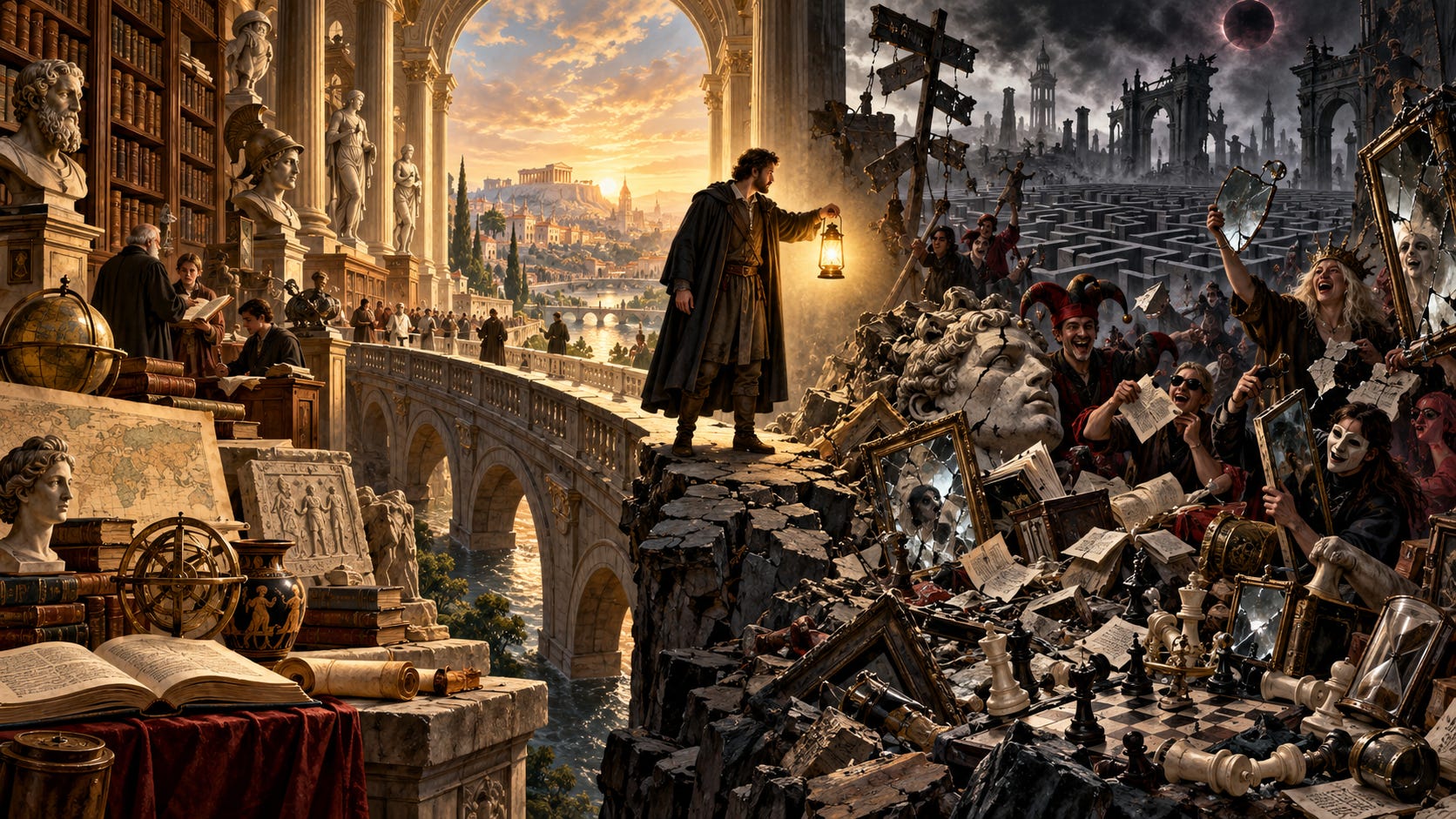
There is a peculiar phenomenon unfolding in our intellectual culture. We seem to have entered an age in which the ability to question established knowledge is increasingly mistaken for the ability to think intelligently. Ideas that generations of scholars, historians, philosophers, and ordinary people have painstakingly examined are suddenly being dragged back into the courtroom of public opinion, not necessarily because new evidence has emerged, but because someone has discovered that challenging the accepted conclusion makes them appear intellectually sophisticated.
We are witnessing what I call the deconstruction of intelligence, a cultural phenomenon in which skepticism, once a valuable instrument for discovering truth, becomes an instrument for dismantling our confidence in knowing anything at all.
Let me be clear. I am not suggesting that we should blindly accept conventional wisdom or surrender our intellectual independence to historians, academics, governments, or institutions. Quite the contrary. I believe questioning authority, challenging assumptions, and examining evidence are indispensable responsibilities of a free-thinking society.
But there is an enormous difference between questioning something because the evidence demands reconsideration and questioning something merely because other people believe it.
Contrarianism is not intelligence. Skepticism is not wisdom. And the rejection of established facts is not evidence of independent thought. Yet increasingly, we behave as though it is.
When Skepticism Becomes an Intellectual Fashion Statement
Every generation has the responsibility to examine the knowledge it inherits. History is imperfectly recorded. Governments lie. Powerful institutions manipulate information. Victors sometimes shape historical narratives to justify their actions while minimizing their own wrongdoing. Entire civilizations have participated in atrocities that subsequent generations conveniently omitted from their history books.
These realities should make us careful consumers of information. They should encourage humility, research, and a willingness to revise our understanding when credible evidence emerges. However, acknowledging that history can be distorted does not mean every historical conclusion is therefore unreliable. The problem begins when skepticism stops being a method of investigation and becomes an identity.
For some people, being the person who disagrees with everyone else has become more important than being the person who is correct. They appear to derive intellectual satisfaction from occupying whichever position is least socially acceptable, as though the unpopularity of an argument somehow establishes its credibility.
The logic is remarkably simple. If most people believe something, it must be propaganda. If historians generally agree about an event, they must be protecting an official narrative. If an institution condemns an ideology, perhaps that ideology has been misunderstood.
Notice what has happened. The individual has not escaped intellectual conformity. He has merely inverted it. Instead of believing something because everyone else believes it, he disbelieves it for precisely the same reason. Neither approach is independent thinking. An intellectually independent person follows evidence wherever it leads, even when that evidence supports the conventional conclusion.
The Strange Rehabilitation of History’s Worst Chapters
Consider some of the historical questions being revisited in contemporary discourse. We now encounter arguments questioning whether Nazi Germany truly needed to be defeated, whether oppressive Islamist regimes are actually as tyrannical as they have been portrayed, or whether historical accounts of the Ottoman Empire’s brutality toward Christian populations have been exaggerated.
These are not all identical questions, and their historical circumstances deserve separate examination. But they illustrate a disturbing intellectual temptation: treating well-documented atrocities as though their reality becomes questionable simply because someone offers a provocative reinterpretation.
The crimes of Nazi Germany are not established merely because the Allies won World War II. They are documented through German government records, military orders, photographs, eyewitness testimony, concentration camp evidence, and the Nazis’ own descriptions of their activities.
One can reasonably debate Allied strategic decisions, the conduct of individual governments, or the political consequences of the war without pretending that the fundamental moral character of the Nazi regime remains an open question.
Likewise, one can acknowledge the Ottoman Empire’s extraordinary cultural, architectural, and administrative accomplishments without denying the persecution and mass killing of Armenian Christians, particularly during the genocide of 1915 and 1916.
And one can distinguish between Islam as a religion, its diverse adherents, and particular authoritarian governments while recognizing documented restrictions on women’s rights, religious freedom, and political dissent in regimes such as Iran. Historical complexity should sharpen our judgment, not paralyze it.
Recognizing that the victorious side committed wrongs does not automatically make the defeated side righteous. Discovering that a historical figure possessed admirable qualities does not erase his atrocities. Identifying legitimate grievances within a society does not justify every movement that emerges in response. Context can explain evil without excusing it. That distinction should not require extraordinary intellectual courage to defend.
The Difference Between Revising History and Erasing Knowledge
Imagine a civilization that discovers how to build a bridge capable of safely carrying thousands of vehicles. Engineers study structural failures, refine their calculations, and establish reliable principles of construction.
Now imagine a new generation arriving and declaring that all previous engineering knowledge is suspect because some bridges have collapsed and some engineers have made mistakes.
Instead of building on what their predecessors learned, they insist on rediscovering the principles of structural integrity from scratch. We would hardly call this progress. Yet something remarkably similar is occurring in our intellectual culture.
Civilization advances through the accumulation of knowledge. Each generation inherits discoveries, mistakes, warnings, and principles that allow it to begin further along the path than those who came before. This inheritance does not make us infallible. It makes progress possible.
The scientific method itself depends upon this principle. Scientists question existing conclusions, but they do not casually discard established knowledge without evidence strong enough to justify doing so. History deserves the same intellectual discipline.
We should welcome revision when newly discovered documents, better methods, or previously neglected perspectives meaningfully change what we know. Indeed, some of the most valuable historical scholarship has emerged from correcting convenient national myths and restoring the voices of people who were overlooked. But revision requires evidence.
Simply announcing that history was written by the victors is not an argument against a particular historical fact. It is a reason to examine the sources carefully. Otherwise, the phrase becomes a universal solvent capable of dissolving any inconvenient truth. And when everything can be dissolved, nothing can be established.
The Seduction of Feeling Smarter Than Everyone Else
I suspect that part of this phenomenon emerges from a deeply human desire to feel exceptional. There is an undeniable psychological reward in believing that you have discovered something millions of other people have failed to recognize. It allows you to imagine yourself standing outside the machinery of propaganda, looking down upon a population hopelessly trapped within it.
The internet has turned this temptation into an industry. A carefully researched historical explanation may require hours of reading and considerable intellectual humility. A provocative video declaring that everything you learned in school was a lie can generate attention within minutes.
Algorithms reward surprise, outrage, and controversy. Consequently, the person who announces an outrageous reinterpretation of history may receive more attention than the scholar who patiently explains why the interpretation contradicts the evidence.
The danger is that attention becomes confused with authority, confidence with competence, and novelty with discovery. We increasingly judge arguments by how dramatically they challenge our assumptions rather than how successfully they withstand scrutiny. But intelligence is not measured by the number of accepted ideas a person manages to reject.
It is measured, in part, by the ability to distinguish truth from falsehood, recognize the limits of one’s knowledge, evaluate competing evidence, and reach conclusions proportionate to the strength of that evidence.
Sometimes the intelligent conclusion is revolutionary. Sometimes it is remarkably conventional. The objective is not to be different. The objective is to be right.
Moral Clarity Is Not Intellectual Simplicity
There is another consequence of this intellectual deconstruction that concerns me even more than historical confusion. When we become obsessed with finding alternative explanations for every atrocity, we risk losing the moral vocabulary necessary to condemn evil.
Certainly, the world is complicated. Human beings are rarely motivated by a single cause, and historical events seldom unfold according to simplistic narratives of entirely virtuous heroes confronting entirely wicked villains. But complexity does not eliminate moral responsibility.
We can recognize that a tyrant experienced personal suffering without excusing his tyranny. We can investigate the grievances that contributed to a terrorist movement without justifying terrorism. We can acknowledge the failures of Western governments without concluding that their authoritarian adversaries are therefore morally superior.
I believe human beings possess an inherent dignity that neither governments nor ideological movements have the authority to revoke. Our rights do not depend upon our usefulness to the state, our religious identity, or our political conformity.
That conviction provides a moral standard by which we can evaluate history, including the actions of our own nation. To acknowledge that America has committed injustices does not require us to abandon the principles upon which America was founded. Indeed, those principles provide some of the strongest arguments for recognizing and correcting our failures.
The pursuit of a more perfect union requires the ability to distinguish an imperfect application of a principle from a defective principle. Without that distinction, even our most important moral achievements become vulnerable to fashionable revisionism.
Reconstructing Intelligence Around Truth
So how do we resist this cultural trend? We begin by restoring the distinction between skepticism and cynicism. Skepticism asks what the evidence supports. Cynicism assumes that whatever is widely accepted must conceal a deception.
We must also recover our respect for intellectual inheritance. The fact that our ancestors were imperfect does not mean they learned nothing worth preserving. Their discoveries, experiences, and sacrifices are resources from which we should draw wisdom.
We must become more disciplined about the burden of proof. Extraordinary revisions of well-established historical conclusions require substantial evidence, not merely an entertaining alternative narrative.
And perhaps most importantly, we must recover the humility to acknowledge that intelligence sometimes requires accepting a conclusion we did not personally discover. There is no shame in standing upon the shoulders of those who came before us. The shame would be in destroying the foundation they built simply to experience the temporary satisfaction of appearing original.
I want my children to question what they are taught. I want them to challenge authority when necessary, confront falsehood courageously, and refuse to surrender their judgment to the crowd. But I also want them to recognize truth when they encounter it, regardless of whether it is fashionable, controversial, ancient, or universally accepted.
Because the purpose of intelligence is not endless interrogation. It is the pursuit of understanding. And understanding must eventually permit us to reach conclusions.
A civilization that cannot distinguish settled evidence from speculative revision will spend its future endlessly retrying its past. It will squander the wisdom accumulated through generations of experience while congratulating itself for having the courage to question everything. We can do better.
We can remain intellectually curious without becoming intellectually reckless. We can examine history honestly without rehabilitating atrocities. We can celebrate independent thought without worshipping contrarianism. And we can acknowledge uncertainty without pretending that certainty is always impossible.
The highest expression of intelligence is not the courage to doubt everything. It is the discipline to know what deserves doubt, what demands further investigation, and what the evidence has already established.
Ultimately, intelligence must serve truth rather than personal vanity. Otherwise, we risk producing a generation of people who know how to dismantle every argument but possess neither the wisdom nor the conviction to build anything in its place.
“Intelligence is not demonstrated by how many truths we can question, but by how faithfully we can distinguish the truths worth preserving from the falsehoods worth rejecting.” — Alma Ohene-Opare